A
ACQ (Alkaline Copper Quaternary) – Modern timber preservative treatment widely used as a lower-toxicity alternative to CCA.
A-frame – Temporary triangular timber structure used for support, lifting or bracing.
Architrave – Decorative moulded trim installed around doors and windows to conceal joints and movement gaps.
Actual Size – The finished dimension of timber after dressing (smaller than nominal size).
Adhesive Failure – Separation in engineered timber due to glue bond breakdown.
B
Back sawn – Timber cut tangential to growth rings, typically producing cathedral grain patterns.
Barge board – Board fixed to gable ends to conceal roof framing and provide a finished edge.
Batten – Narrow timber strips used for fixing cladding, roofing, or panelling.
Bearer – Primary horizontal support member carrying joists in floors or decks.
Bevel – Angled cut or edge detail used for joins or visual refinement.
Bird board – Eaves closure board preventing pest or bird entry.
Blackbutt – Durable Australian hardwood frequently specified for decking and flooring, known for fire performance.
Blue board – Cement-based fibre sheet commonly used as cladding substrate or wall lining.
Blue pine – Treated radiata pine, dyed for identification, used in structural framing.
Bracing – Diagonal structural elements preventing racking or lateral movement.
Bullnose – Rounded timber edge profile commonly used on stair treads and decking.
Bushfire Attack Level (BAL) – Compliance rating defining exposure risk and material suitability.
Butt joint – Simple square-ended timber joint.
Blocking – Short timber pieces installed between framing members for stiffness or fixing support.
C
Cantilever – Structural member extending beyond its support.
CCA Treatment – Copper Chrome Arsenate preservative treatment for durability (legacy but still recognised).
Centres – Framing spacing measured from member midpoint to midpoint.
Chamfer – 45-degree edge cut for safety or detailing.
Chalk line – Marking tool for establishing straight lines.
Chipboard / Particleboard – Engineered board from compressed wood particles and resin.
Chippy – Trade slang for carpenter.
Cladding – Timber boards or panels forming external wall finishes.
Cumaru – Extremely dense imported hardwood used in high-wear external environments.
Cupping – Curvature across board width due to moisture imbalance.
Cypress Pine – Naturally termite-resistant Australian softwood used structurally and decoratively.
Checking – Surface cracking from drying stresses.
Clear Grade – Timber selected for minimal visual defects.
D
Dado – Lower wall section often finished with panelling or mouldings.
Decking – Boards designed for external walking surfaces.
Defects – Natural or machining irregularities (knots, splits, twist).
Delamination – Separation of bonded layers in engineered timber.
Dowel – Cylindrical timber pin used in joinery alignment.
Dressed All Round (DAR) – Timber machined smooth on all faces.
Dressed Timber – Planed timber with a finished surface.
Durability Class – Rating of timber’s natural resistance to decay and insects.
Density – Mass per volume influencing strength, durability and fixings behaviour.
E
End Grain – Exposed fibre structure at board ends.
End Matched – Boards with joining profiles machined into ends.
Engineered Timber – Manufactured products such as LVL, plywood and glulam.
Equilibrium Moisture Content (EMC) – Stable moisture level timber reaches in service conditions.
Edge Glued Panel – Board formed by bonding narrow timber strips.
F
Face – Visible or best-quality surface of timber.
Fascia – Board fixed to roof edges supporting gutters.
Fiddleback – Decorative wavy grain figure.
Finger Jointed (FJ) – Timber lengths joined using interlocking profiles.
Fire Retardant – Treatment or coating reducing flame spread.
Fixings – Nails, screws, bolts and connectors.
FOHC (Free of Heart Centre) – Timber milled away from log centre to improve stability.
Formply – Film-faced plywood for concrete formwork.
Framing Grade – Timber classification suitable for structural applications.
G
Gable – Triangular wall beneath a pitched roof.
Glulam (Glue-Laminated Timber) – Engineered structural beams made by bonding laminations.
Grade – Strength or appearance classification.
Green Timber – Unseasoned timber with high moisture content.
Grey Box / Grey Ironbark – Dense hardwoods suited to demanding external use.
Grain Direction – Fibre orientation affecting movement and machining.
Growth Rings – Annual tree growth layers influencing stability.
H
Hardboard – Compressed fibre sheet material.
Hardwood – Timber from broadleaf species, generally denser and more durable.
Hazard Classes (H1–H6) – Treatment categories defining exposure suitability.
Header – Load-transferring beam over openings.
Heartwood – Inner timber with enhanced natural durability.
Handrail – Safety rail installed along stairs or decks.
Hygroscopic – Property of timber to absorb/release moisture.
I
I-Joist – Engineered structural member with high strength-to-weight efficiency.
Ironbark – Exceptionally hard Australian hardwood.
Interlocking Grain – Alternating fibre direction affecting finish quality.
J
Janka Hardness – Measure of timber resistance to denting and wear.
Jarrah – Durable WA hardwood prized for stability and appearance.
Joist – Horizontal support member for flooring or decking.
Joist Hanger – Metal bracket securing joists.
K
Karri – Australian hardwood used in structural and appearance applications.
Kiln-Dried (KD) – Timber dried in controlled conditions for stability.
Kiln Burn – Discolouration from drying irregularities.
L
Lintel – Structural beam across openings.
Load Bearing – Structural component designed to carry loads.
LOSP Timber – Light Oil Surface Preservative treated timber for above-ground exposure.
LVL (Laminated Veneer Lumber) – Engineered high-stability structural timber.
Lyctine Susceptible – Timber prone to lyctine borer attack.
Lamination – Bonded timber layers forming structural members.
M
MDF (Medium Density Fibreboard) – Engineered board for joinery and interiors.
Merbau – Popular durable hardwood decking species.
Mitre Joint – Angled corner joint.
Moisture Content (MC) – Water percentage affecting timber behaviour.
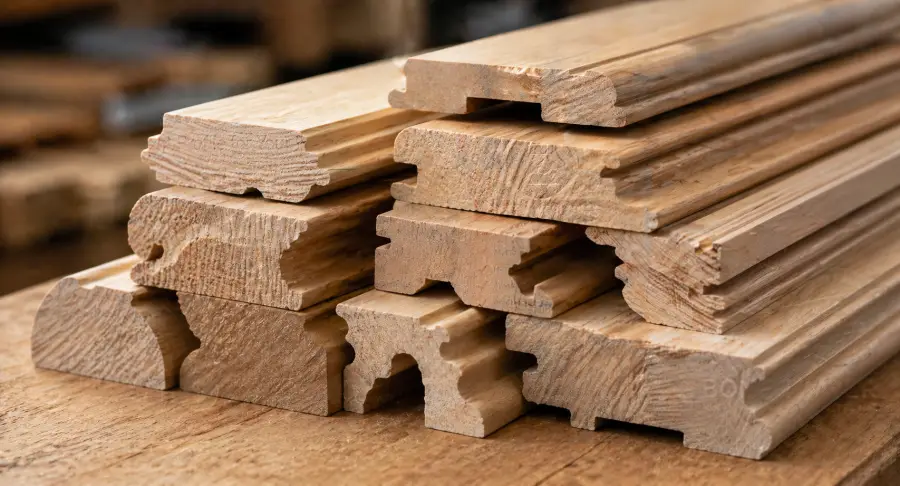
Mouldings – Profiled finishing trims.
Movement – Dimensional change from moisture variation.
Machine Stress Graded (MSG) – Structurally graded timber assessed mechanically.
N
Nogging – Short bracing pieces between studs.
Nominal Size – Pre-dressed timber dimension reference.
Non-Load Bearing – Component not designed to carry structural loads.
Nosing – Rounded stair tread edge.
O
Oregon (Douglas Fir) – Structural softwood used in beams and framing.
OSB (Oriented Strand Board) – Engineered structural sheet product.
Overlay Flooring – Thin timber flooring installed over substrate.
P
Parquetry – Patterned timber flooring system.
Plywood – Cross-laminated veneer sheet product.
Plank – Long wide timber board.
Plinth – Protective base board at wall junctions.
Plate (Top/Bottom) – Horizontal framing members.
Posts – Vertical structural supports.
Porous – Material prone to moisture absorption.
Prime – Initial protective coating.
Preservative Treatment – Chemical processes improving durability.
Q
Quad – Quarter-round trim moulding.
Quarter-Sawn Timber – Timber cut for improved dimensional stability.
R
Radiata Pine – Widely used Australian plantation softwood.
Ridge Beam – Primary roof apex beam.
Rough-Sawn Timber – Undressed timber with textured finish.
Random Length – Timber supplied in varied lengths.
Riser – Vertical stair component.
Racking – Lateral structural distortion resisted by bracing.
S
Sapwood – Outer lighter timber layer.
Seasoned Timber – Timber dried for stability.
Secret Nailing – Concealed fixing method.
Select Grade – Higher appearance classification.
Shrinkage – Size reduction from drying.
Skirting – Internal perimeter moulding.
Softwood – Timber from conifer species.
Span – Distance between structural supports.
Span Table – Engineering reference for load capacity.
Stud – Vertical framing member.
Structural Timber – Timber graded for load-bearing use.
Surface Check – Minor drying crack.
T
Tallowwood – Dense Australian hardwood suited to wet conditions.
Tannins – Natural compounds causing staining/leaching.
Termite Resistant – Timber naturally or chemically protected.
Timber Frame – Structural system built from timber members.
Tongue & Groove (T&G) – Interlocking board profile.
Treated Pine – Pine preserved for durability.
Truss – Engineered structural framework.
Twist – Spiral distortion along timber length.
U
Underlay – Sub-layer beneath flooring.
Uniform Grain – Consistent fibre pattern.
Unseasoned Timber – High-moisture timber prone to movement.
V
Veneer – Thin timber sheet for appearance or stability.
V-Joint (VJ) – Decorative joint profile.
Void – Empty structural cavity.
W
Warping – Distortion from moisture imbalance.
Weatherboards – External overlapping cladding boards.
Western Red Cedar – Lightweight stable cladding timber.
Wind Load – Structural force consideration.
Workability – Ease of machining or fixing.
Wane – Missing wood or bark edge.
Wet Service Conditions – Environments with sustained moisture exposure.
Z
Zoning (Building) – Local planning controls affecting construction methods and materials.
 Call Bone Timber: (08) 8297 8277
 Email our team: sales@bonetimber.com.au